The short answer
A print-in-place (PIP) toy is a 3D printed design with moving parts that prints as one job, with every part already linked to the next. The designer leaves a tiny gap between parts that touch, so they print separately but can't come apart. When the print is finished, the joints are loosened once and then move freely.
How print-in-place works
A home 3D printer builds an object one thin layer of melted plastic at a time, from the bottom up. Normally, two parts printed touching each other fuse into one solid piece. Print-in-place designs avoid that on purpose.
- Gaps instead of glue. Wherever two parts meet, such as a hinge pin inside its hole or one tail segment inside the next, the designer leaves a small clearance, often well under a millimeter. The plastic on each side cools separately, so the parts stay apart.
- Shapes that lock. Joints are shaped so the parts can't slide out: a pin with a wider head, a hook through a loop, a ball inside a socket. The parts are trapped together from the moment they're printed.
- Built to print flat. Most print-in-place toys lie flat on the printer bed. That's why many flexi animals look segmented, like a row of links: each segment has to print without support material stuck inside the joint.
Right off the printer, the joints can feel a little stiff. Bending each one gently a few times breaks any thin strands of plastic and frees it up. After that, it moves smoothly.
Print-in-place, articulated and flexi: what's the difference?
People use these words loosely. Here's how we use them.
| Word | What it means | Example in the shop |
|---|---|---|
| Articulated | Has joints, so it bends, poses or wiggles. Says nothing about how it was made. | Articulated Orca |
| Print-in-place | Prints as one piece with the moving parts already connected. No assembly. | Trenchy Excavator |
| Flexi | The maker-community name for print-in-place animals with a chain of jointed segments. | Flexi Rex |
| Snap-together kit | Printed as separate parts that click together by hand, no glue. Often more poseable. | Dummy 13 Action Figure |
So a flexi dragon is articulated and print-in-place, while a snap-together action figure is articulated but not print-in-place. Not sure which kind a product is? Ask us before you order.
Why people like them
- They're fidgets. A flexi animal is something to bend, curl and wiggle while you think. Many people keep one on their desk for exactly that.
- No loose hardware. There are no screws or pins to lose, and nothing to put together.
- They show off what 3D printing can do. A working hinge or a jointed tail that came out of a printer in one go still surprises people who haven't seen it before.
- They look good on a shelf. A curled-up dragon or a posed orca is a decoration as much as a toy.
Print-in-place toys you can buy
All of these are in the LayerUp shop, printed to order in PLA in red, black, blue or green. Download counts are each design's public total on Printables, captured November 27, 2026.
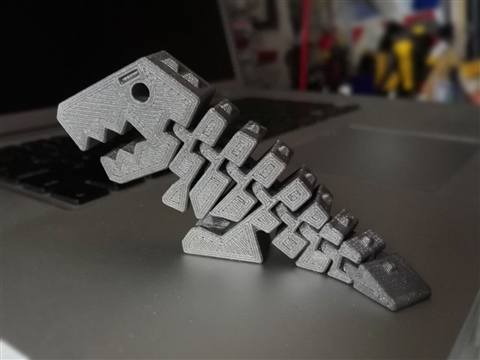
Flexi Rex
The best-known flexi design: a T. rex whose body and tail are a chain of links. This version has stronger links.
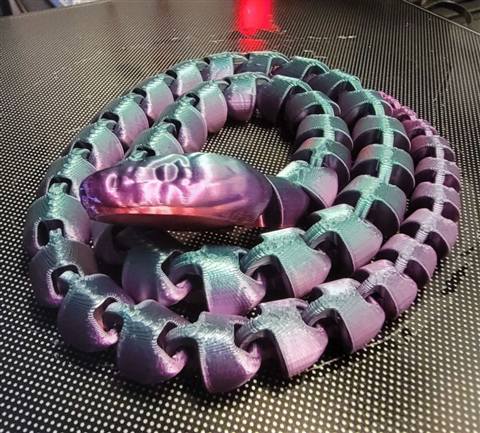
Articulated Snake
A long, smooth snake printed in one piece that slithers when you move it.
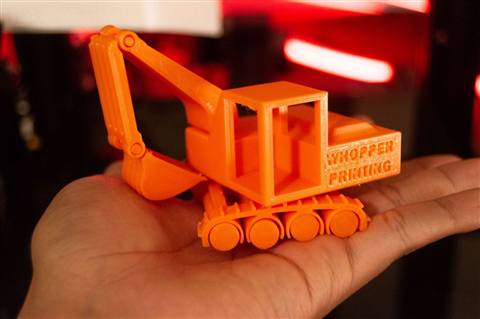
Trenchy Excavator
Proof that print-in-place isn't just animals: the arm, bucket and cab all move.
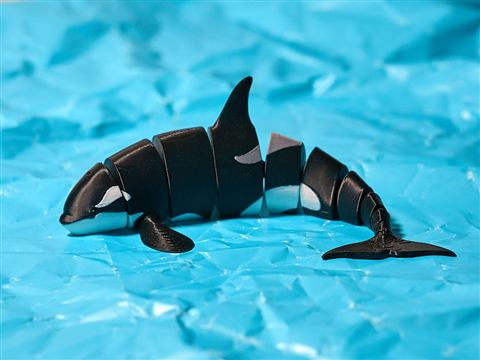
Articulated Orca
A killer whale whose body swishes side to side, with moving flippers and tail.
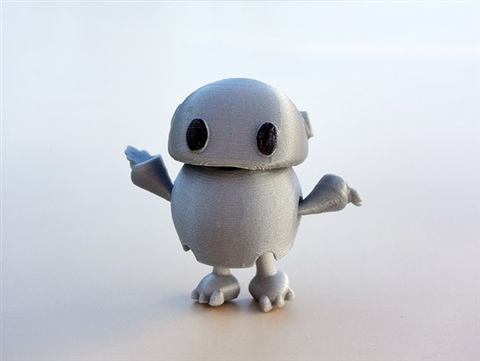
Mini Articulated Robot
A small round robot with arms, legs and a head that really move.
More: Flexi Cat, Flexi Hedgehog, Sea Turtle Flexi, Spiky Dragon and Pop-Up Catapult, which prints flat with working hinges. Several fidgets are print-in-place too, like the Infinity Cube and Planetary Gear Bearing. See every one in the Articulated category.
Looking after moving parts
- Bend, don't force. Every joint has a range. Pushing past it can snap a thin link.
- Keep it cool. PLA softens at about 55–60 °C (131–140 °F), and a warped joint won't move freely again. Don't leave prints in a hot car. More PLA care tips.
- Clean gently. Lukewarm water and a soft brush get dust out of joints. Let it dry fully.
- Not for little kids. Our prints are for ages 13 and up. Small parts can be a choking hazard for children under 3.
Quick questions
Do print-in-place toys need assembly?
No. That's the point: they come off the printer with the joints already connected. Snap-together kits are different, because their parts are printed separately.
Can they break?
Yes. They're rigid plastic, and the thinnest links are the weak spots. Normal bending and wiggling is fine; bending hard past a joint's limit, stepping on one or leaving it in heat is what breaks them.
Who designs them?
Independent designers who share files on sites like Printables. Every LayerUp product names its designer and links the original. See the design credits.
Find your flexi
Spin each one in 3D, in the color you pick, before you order.